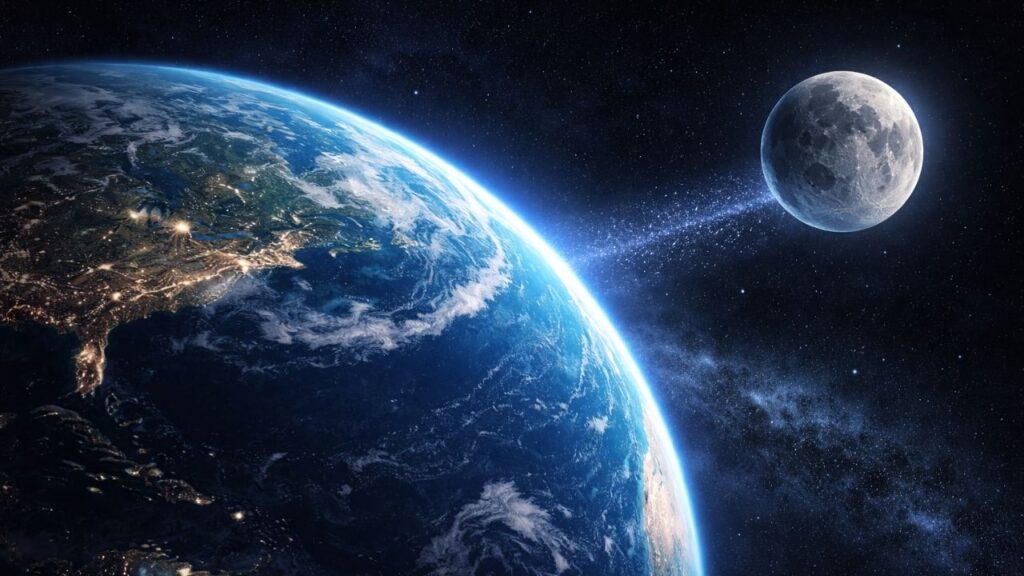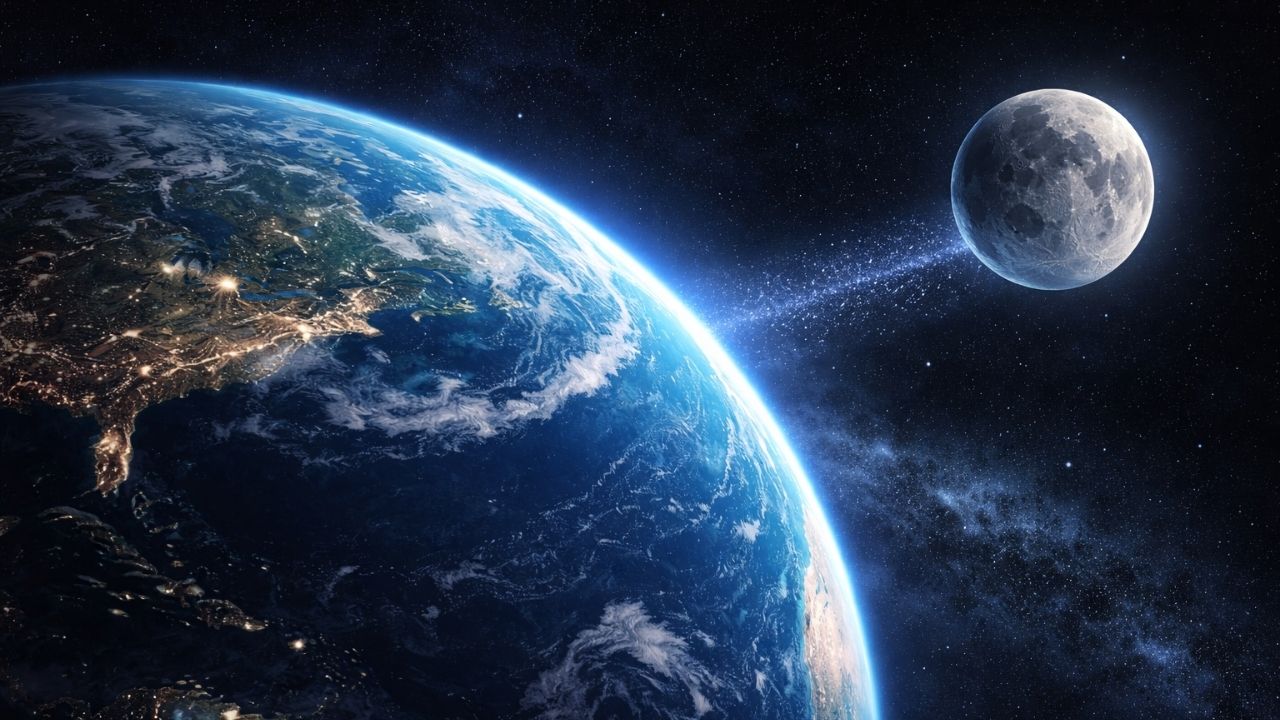
It’s happening right now, and almost no one notices. The Moon—our constant companion in the night sky—is quietly drifting away from Earth. Just a few centimeters each year, slow enough to ignore, but powerful enough to reshape the length of our days, the rhythm of our oceans, and even the future of life on this planet. This isn’t science fiction. It’s a measurable, ongoing process—and scientists say its long-term effects are bigger than most people realize.
A Slow Cosmic Drift You Can’t See

The latest measurements show the Moon is moving away from Earth at about 3.8 centimeters per year—roughly the speed your fingernails grow. It’s incredibly slow, but over millions of years, that tiny shift adds up.
Scientists confirmed this using laser reflectors left on the Moon during Apollo missions. By bouncing lasers off these reflectors and measuring the return time, they can track the Moon’s distance with extreme precision.
Latest Stories
 A Mysterious Interstellar Object Is Racing Toward Our Solar System—Here’s What Scientists Know
What sounds small is actually part of a massive cosmic exchange: as the Moon moves away, Earth’s rotation slows down. That means our days are gradually getting longer—even if we can’t feel it yet.
Why the Moon Is Moving Away
The reason comes down to gravity and motion. The Moon pulls on Earth’s oceans, creating tides. But because Earth spins faster than the Moon orbits, those tidal bulges get pulled slightly ahead.
That small shift creates a gravitational tug that pushes the Moon outward into a higher orbit. At the same time, Earth loses a bit of its rotational energy—so it spins more slowly.
It’s a quiet trade happening every single day:
- The Moon gains distance
- Earth loses speed
This process has been happening for billions of years—and it’s still ongoing.
Earth Once Had 5-Hour Days
If you could travel back to early Earth, the planet would feel completely different. Days lasted just 5 to 6 hours, and the Moon appeared much larger in the sky.

Back then, the Moon was much closer, and its gravitational pull was stronger. Tides were massive—far more intense than what we see today—reshaping coastlines and possibly playing a role in the early development of life.
Over time, as the Moon drifted away, Earth’s rotation slowed. That’s how we went from ultra-short days to the familiar 24-hour cycle we live by today.
What’s Happening to Our Oceans
The Moon’s distance directly affects tides. When it was closer, tides were stronger and more dramatic. As it moves farther away, its pull weakens slightly.
This doesn’t mean tides are disappearing—but over geological time, they are becoming less intense Today’s tides are also influenced by:
- The shape of coastlines
- Ocean depth
- Earth’s rotation
- The Sun’s gravity
Still, the Moon remains the dominant force. And as it drifts away, the overall “energy” of tides slowly softens.
The Hidden Impact on Life on Earth
Tides aren’t just about ocean movement—they shape ecosystems. Coastal life depends on them for feeding, reproduction, and survival.

Many species—from shorebirds to marine organisms—are synchronized with tidal cycles. Some corals even spawn based on lunar phases . As tidal strength slowly changes over millions of years, ecosystems will adapt. But the shift highlights something important. The Moon isn’t just lighting our nights—it’s helping regulate life on Earth.
Days Are Getting Longer (Very Slowly)
You won’t notice it, but Earth’s day is already increasing in length. Scientists estimate that days grow longer by about 1.7 milliseconds per century.
That might sound tiny—but over hundreds of millions of years, it becomes significant. Fossil evidence, like ancient coral growth patterns, shows that:
- Earth once had over 400 days in a year
- Days were shorter, around 20 hours or less
In the future, days could reach 25 hours—but not anytime soon.
What Happens Next?
Looking far into the future, the Earth-Moon system will continue evolving. The Moon will keep drifting away, and Earth will keep slowing down.
There’s even a theoretical possibility of tidal locking, where Earth and the Moon always show the same face to each other. But in reality, the Sun’s evolution will likely disrupt everything long before that happens.

Still, the long-term trend is clear:
- Longer days
- Slightly weaker tides
- A slowly changing Earth-Moon relationship
It’s a reminder that even the most stable things in our sky are constantly changing.
Why This Matters More Than You Think
This isn’t just an interesting space fact—it’s part of Earth’s deep history and future. The Moon plays a critical role in:

- Stabilizing Earth’s tilt (which controls seasons)
- Influencing climate over long periods
- Shaping ocean behavior and ecosystems
Without the Moon, Earth could be far less stable—and possibly less hospitable to life. So while it may look unchanged in the sky, the Moon is quietly shaping the planet in ways we’re only beginning to fully understand.
FAQs
1. Is the Moon really moving away from Earth?
Yes. Scientific measurements confirm the Moon is receding at about 3.8 cm per year due to tidal interactions.
2. Why does the Moon moving away make days longer?
Because energy is transferred from Earth’s rotation to the Moon’s orbit, slowing Earth’s spin and increasing day length.

3. Will we notice longer days in our lifetime?
No. The change is extremely small—only milliseconds over a century.
4. Are tides getting weaker because of this?
Very slowly, yes. But local tides are influenced more by geography and ocean conditions in the short term.
5. Could the Moon ever leave Earth completely?
No. It will continue moving away but remain gravitationally bound to Earth under current models.

6. Did the Moon used to look bigger?
Yes. Billions of years ago, it appeared much larger and caused stronger tides.
7. Does the Moon affect Earth’s climate?
Yes. It helps stabilize Earth’s tilt, which plays a key role in maintaining stable seasons and climate patterns.