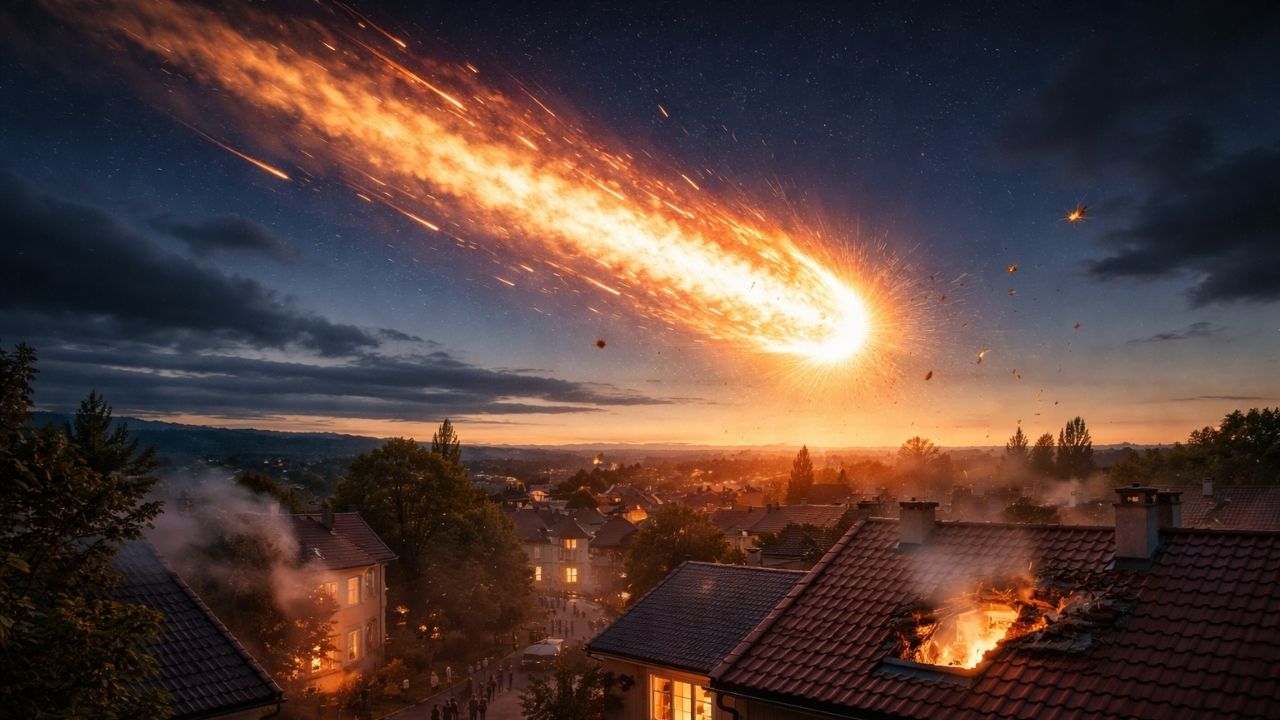
What started as a bright streak in the evening sky quickly turned into something far more dramatic. Within seconds, a blazing fireball lit up northern France, followed by a powerful sonic boom that rattled homes across borders.
Residents thought it might be an explosion or even something man-made. But as the dust settled, scientists confirmed something extraordinary: a rare meteorite fall that could reveal secrets billions of years old.
From Spectacle to Impact: What Actually Happened
On March 8, 2026, at around 6:55 pm, a fast-moving object entered Earth’s atmosphere over northern Europe. As it burned through the sky, it created an intense flash of light visible across large parts of France and Germany.

Moments later, a loud sonic boom followed. Windows shook, people rushed outside, and in one case, debris reportedly punched through a residential roof. What looked like a stunning sky event quickly became a real-world incident with physical impact.
Meteor, Missile, or Space Debris? Early Confusion Explained
In the immediate aftermath, there was confusion. Events like this often trigger speculation, especially when accompanied by loud explosions and damage.
Authorities initially considered multiple possibilities, including space debris or military activity. But early analysis of the fragments and flight path pointed to a natural cause—a meteorite entering Earth’s atmosphere at high speed and breaking apart before reaching the ground.

Why Scientists Are Calling This a ‘Rare Opportunity’
While the event startled residents, it sparked excitement in the scientific community. Meteorites that survive atmospheric entry and reach the ground are relatively rare, especially when fragments can be recovered quickly.
These pieces are essentially time capsules from space. Formed billions of years ago, they carry information about the early solar system—long before Earth looked the way it does today.
Researchers are now analyzing the recovered fragments to understand their composition, origin, and age. The findings could offer clues about how planets formed and even how the building blocks of life developed.

What Makes This Meteorite So Valuable
Not all meteorites are equal. The value of this event lies in how quickly fragments were located and preserved, reducing contamination from Earth’s environment.
Fresh samples allow scientists to study original materials—such as ancient minerals and organic compounds—that are otherwise difficult to examine. This helps researchers reconstruct conditions from the early solar system with greater accuracy. In simple terms, it’s like getting a direct sample from space history.
The Real-World Impact on Residents
For people living in the affected areas, the event was anything but abstract. The sonic boom was strong enough to shake buildings, and reports of minor structural damage added to the shock.
Latest Stories
 Scientists Warn Arctic Atmosphere Is Shifting Fast—Why Early February Could Trigger Extreme Weather Worldwide
While no major injuries were reported, the experience left many residents unsettled. Events like this are rare, but they serve as a reminder that Earth is constantly interacting with objects from space. Authorities responded quickly, securing affected areas and assisting with debris recovery efforts.
What Happens Next in the Investigation
Now that fragments have been collected, the focus shifts to laboratory analysis. Scientists will examine chemical composition, structure, and isotopic signatures to determine where the meteorite originated.
At the same time, researchers are comparing this event with past meteorite falls to understand how common—or unusual—it really is. Early indications suggest this could become one of the more significant meteorite discoveries in recent years.

A Reminder of Our Place in Space
Events like this don’t happen often, but when they do, they capture global attention for a reason. They remind us that Earth is not isolated—it’s part of a much larger cosmic system.
Most objects burn up harmlessly in the atmosphere. But occasionally, one makes it through, leaving behind both damage and discovery. In this case, what began as a flash in the sky has turned into a scientific moment that could reshape what we know about the universe.