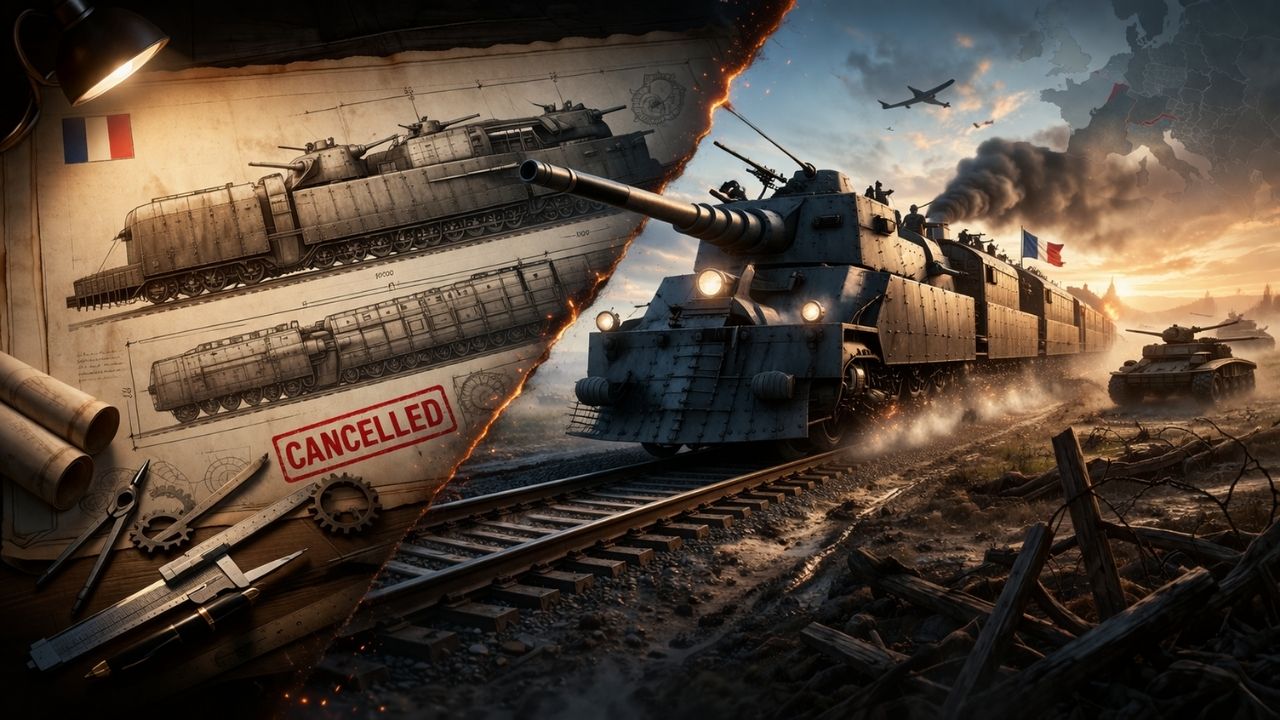
It sounded like the future of warfare—a 60-ton armored train packed with heavy guns, thick steel, and unstoppable force. In the 1930s, this wasn’t fiction. It was a serious proposal backed by one of France’s biggest industrial minds.
But despite the excitement, the project never left the drawing board. And the reason why reveals something surprising: sometimes, the biggest and most powerful ideas simply don’t work in the real world.
The Vision Behind the “Moving Fortress”

The idea came from Eugène Schneider, a major figure in France’s defense industry. He imagined a new kind of weapon—an armored train that wasn’t just support equipment, but a full combat system.
Latest Stories
 A 12,000-Year-Old Discovery in Turkey May Change What We Know About Early Human Belief
This train would include a locomotive, a command center, and a heavily armored combat section. Inside, it would carry machine guns, anti-tank weapons, and a main gun powerful enough to take on enemy armor. The goal was simple: create a mobile fortress that could move along rail lines and dominate the battlefield.
At the time, it sounded revolutionary. A weapon that combined protection, firepower, and mobility in one massive platform.
Why the Idea Seemed Ahead of Its Time
In the years between World War I and World War II, military thinking was changing fast. Countries were experimenting with tanks, mechanized units, and new forms of warfare.

Railways were still vital for moving troops and supplies, so combining them with heavy weapons made sense. Armored trains already existed, but Schneider’s concept pushed the idea much further—turning it into a frontline weapon instead of just a support tool.
With Europe rearming and tensions rising, bold ideas like this gained attention quickly. The world was looking for the next big advantage.
The Engineering Reality Was Far More Complicated
Once engineers began looking closer, the challenges became clear. A 60-ton train required enormous power just to move. Its heavy armor added even more strain, and designing a system that could stay stable on tracks while carrying large weapons was extremely complex. Every detail—from braking to balance—became a major engineering hurdle.
Latest Stories
 Detroit Red Wings Sign Jacob Bernard-Docker to Two-Year Deal, Prioritizing Defensive Stability Over Prospect Rotation
There was also a strategic problem. Unlike tanks, the train could only move along fixed rail lines. That made it predictable and easier to target. In a fast-changing battlefield, that limitation was hard to ignore.
Why the Project Was Ultimately Abandoned
Despite early interest, the French military decided not to move forward with the idea.
Cost was a major factor. Building such a large and complex machine would require significant resources. But more importantly, warfare itself was changing. Speed and flexibility were becoming more important than size and armor.
Latest Stories
 HBO Unveils First Harry Potter Series Teaser, Confirms 2026 Release as New Cast Steps Into Iconic Roles
Tanks like the Char B1 and Somua S35 offered mobility that trains simply couldn’t match. They could move across fields, adapt to terrain, and respond quickly in combat. Compared to that, a rail-bound fortress started to look outdated before it was even built.
A Turning Point in Military Thinking
The failure of this project reflects a bigger shift in military strategy. For years, bigger weapons were often seen as better. But by the late 1930s, that idea was changing. Success in modern warfare depended more on movement, coordination, and adaptability.
This armored train concept became one of the last examples of a “bigger is better” approach before military thinking fully shifted toward speed and efficiency.
Latest Stories
 Rain Interrupts Sheffield Shield Final After Victoria’s Fast Start Puts South Australia Under Pressure
What This Story Still Means Today
Even though the armored train was never built, it still matters. It shows how innovation works—how bold ideas push boundaries, even if they don’t succeed. And it highlights a lesson that still applies today: technology must fit the reality of how it will be used.
In many ways, this forgotten project helped shape what came next by showing what not to build.
FAQs
What was the armored assault train concept?
It was a proposed 60-ton military train designed to act as a heavily armored, mobile combat unit with significant firepower.
Latest Stories
 Rising Oil Prices Trigger Building Cost Spike Across Australia, Putting Housing Targets at Risk
Who came up with the idea?
The concept was developed by Eugène Schneider, a French industrialist involved in defense manufacturing.
Why was it never built?
It was considered too expensive, too complex, and less effective compared to faster, more flexible vehicles like tanks.
What made it different from other armored trains?
Unlike earlier versions, it was designed as a complete combat system, not just a rail-based support platform.
Latest Stories
 Powerful Cyclone Narelle Threatens Western Australia Coast, Authorities Warn of Extreme Winds and Urge Evacuations in High-Risk Areas
Was it technically possible to build?
Some aspects were possible, but the overall design posed major engineering and logistical challenges.
How did tanks influence the decision to cancel it?
Tanks offered greater mobility and adaptability, making them more useful on modern battlefields.
Does this idea have any relevance today?
Yes. It serves as a reminder that innovation must balance ambition with practicality, especially in rapidly changing environments.