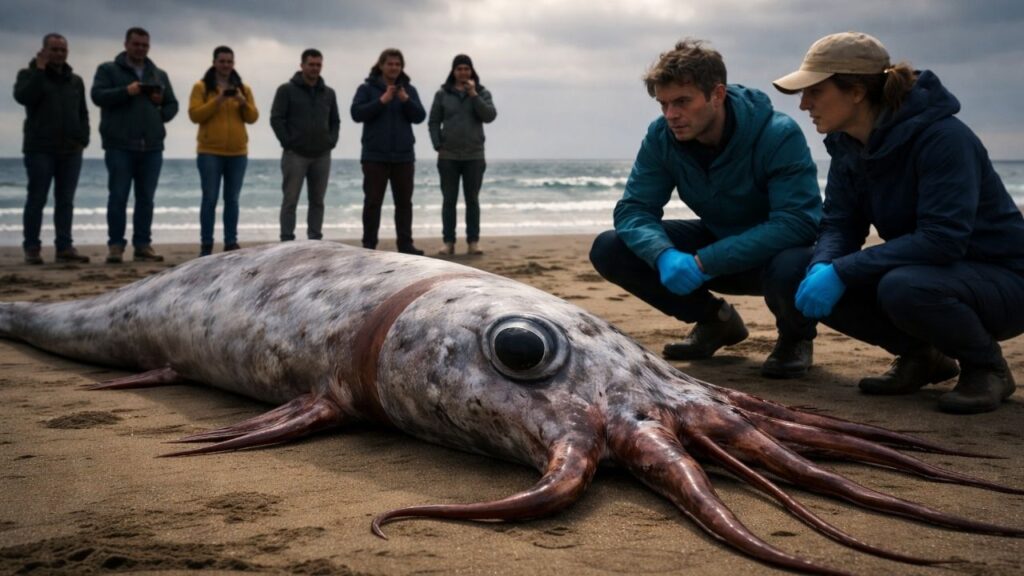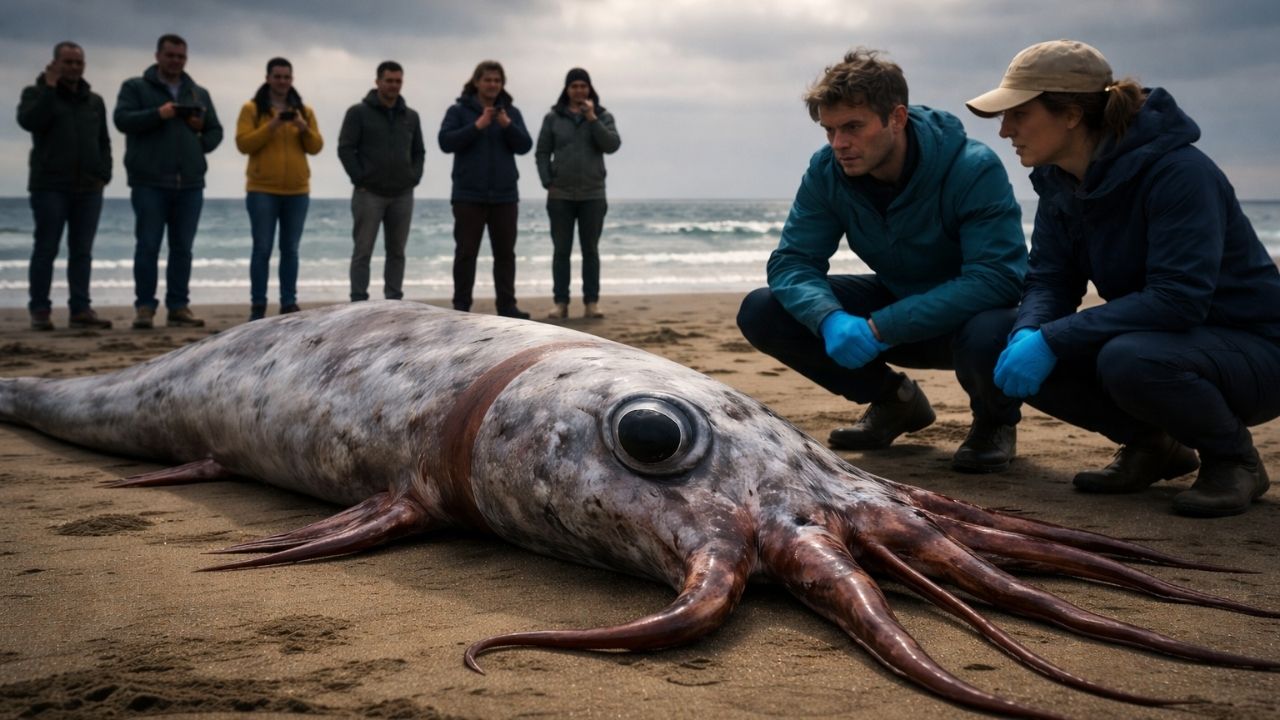
It looked like driftwood at first—until someone got closer. What lay on the sand was something far stranger: a black, leathery fish with sharp, curved teeth and a single glassy eye. Within hours, photos spread online, and a quiet beach turned into the center of scientific attention.
The discovery of a Pacific footballfish—a rare deep-sea anglerfish—on a California shoreline has sparked both fascination and questions. These creatures normally live thousands of feet below the surface, far from human view. So why did one suddenly appear in broad daylight?
What Was Found on the Beach

By mid-morning, small crowds had gathered to see the unusual find. The fish, about two feet long, lay motionless near the waterline. Its dark body, spiny skin, and unmistakable teeth made it look almost unreal.

Marine experts quickly confirmed the identity: a Pacific footballfish, one of the rarest deep-sea species ever seen at the surface. Even seasoned scientists were surprised. Encounters like this are extremely uncommon, making each one valuable for research and understanding life in the deep ocean.
Why This Fish Is So Unusual
The footballfish is built for life in complete darkness. Its most distinctive feature is a glowing lure on its head, used to attract prey in the deep sea. This bioluminescent “lantern” allows it to hunt in an environment where sunlight never reaches.
Its large mouth and inward-curving teeth are designed to trap whatever comes close. In the deep ocean, food is scarce, so the fish must be able to seize opportunities quickly. Everything about its appearance reflects survival in extreme conditions—high pressure, near-freezing temperatures, and total darkness.

A Life Unlike Any Other
One of the most fascinating aspects of anglerfish is their unusual reproduction. In many species, males are tiny compared to females and permanently attach themselves to a female’s body.
Over time, the male fuses with the female, becoming part of her circulatory system and relying on her entirely. This adaptation ensures reproduction in an environment where encounters between individuals are extremely rare. While the beached specimen did not show visible attached males, it still represents a species known for one of the strangest life cycles in nature.
Why Do Deep-Sea Creatures Wash Ashore?
Scientists don’t have a single answer, but several possibilities are being considered. The fish may have been sick, injured, or simply reached the end of its life. Changes in buoyancy or pressure can cause deep-sea animals to rise toward the surface.

Environmental factors may also play a role. Shifts in ocean temperature, oxygen levels, or currents can push creatures out of their usual habitats. While individual strandings are not uncommon in nature, each case helps scientists understand how the deep ocean is changing.
What Happens After Discovery
Once identified, the fish was carefully collected and taken for scientific study. Specimens like this are rare opportunities for researchers to examine deep-sea life up close.
Scientists may study its anatomy, stomach contents, and tissue composition to learn more about its diet, environment, and health. In some cases, such finds are preserved for museums, where they continue to educate the public and support future research.

What This Discovery Means
This event is more than just a curiosity—it’s a reminder of how little we know about the deep ocean. Most of Earth’s oceans remain unexplored, and creatures like the footballfish rarely appear in human environments.
At the same time, it highlights a growing connection between human activity and ocean systems. While one fish doesn’t signal a crisis, repeated or unusual sightings can help scientists track broader environmental changes. Each discovery adds another piece to the puzzle of life beneath the surface.
A Rare Glimpse Into a Hidden World
For those who saw it in person, the experience was unforgettable. For others, it’s a powerful reminder that the ocean still holds mysteries far beyond our reach.
Latest Stories
 Scientists Warn Arctic Atmosphere Is Shifting Fast—Why Early February Could Trigger Extreme Weather Worldwide
Moments like this bring the deep sea closer to everyday life. They remind us that beneath the waves lies a vast, largely unseen world—one that continues to surprise, challenge, and inspire.
FAQs
What is a Pacific footballfish?
It’s a type of deep-sea anglerfish that lives thousands of feet below the ocean surface and uses a glowing lure to attract prey.
How rare is it to find one on a beach?
Extremely rare. Only a small number of these fish have ever been recorded washing ashore.

Are anglerfish dangerous to humans?
No. They live in deep water and rarely encounter humans. A beached specimen poses no threat.
Why do deep-sea fish come to the surface?
Possible reasons include illness, injury, environmental changes, or disruptions in ocean conditions.
Can scientists learn from this discovery?
Yes. Specimens like this provide valuable data about deep-sea ecosystems, diet, and environmental conditions.
Latest Stories
 Massive Fireball Over France Triggers Sonic Boom and Damage—Scientists Confirm Rare Meteorite Fall
Does this mean the ocean is changing?
Not necessarily from a single event, but repeated unusual sightings can help scientists track long-term changes.
What should you do if you find a rare sea creature?
Avoid touching it, take photos, and contact local authorities or marine experts for proper handling.