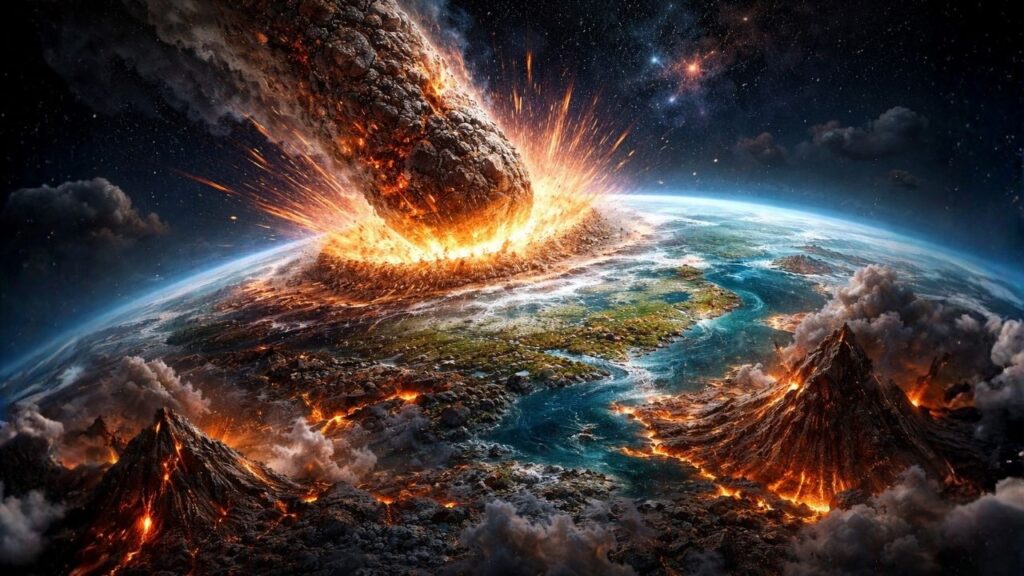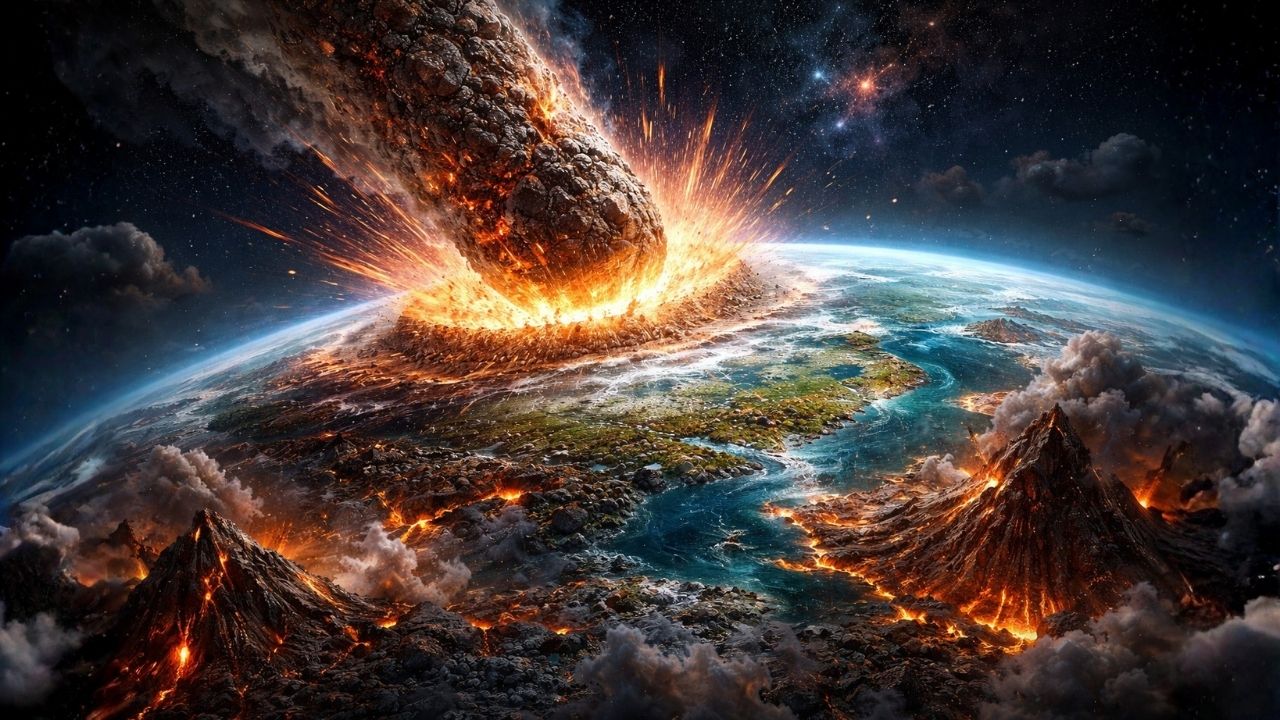
Long before humans, before animals, even before complex life, Earth went through something almost unimaginable. A massive asteroid—twice the size of Paris—crashed into the young planet, triggering chaos on a global scale. The impact was so powerful, it didn’t just reshape the surface—it may have helped set the stage for life itself.
Now, new research and simulations are helping scientists understand just how dramatic this event was. And surprisingly, what looked like total destruction may have played a key role in making Earth habitable.
What Happened When the Asteroid Hit
Around 3.2 billion years ago, Earth was still a very different place—hotter, unstable, and constantly changing. When the asteroid struck, it released an enormous amount of energy, enough to fracture the planet’s crust and send shockwaves across the globe.

The surface likely melted in places, while debris shot into the atmosphere, blocking sunlight. The sky would have turned dark, temperatures dropped, and the environment became extremely hostile. It wasn’t just a regional disaster—it was a planet-wide event that changed everything almost instantly.
How Destruction Created the Building Blocks of Life
Here’s where the story takes an unexpected turn. Despite the devastation, the impact exposed minerals and elements buried deep within Earth’s crust—things like carbon, nitrogen, and phosphorus, which are essential for life.
These materials spread across the surface, creating a nutrient-rich environment. Scientists believe this may have helped early microbial life emerge and grow. In other words, the very event that nearly made Earth uninhabitable may have also made it more suitable for life to begin.

This idea is changing how researchers think about the origins of life—not just on Earth, but potentially on other planets as well.
A Dark Period That Nearly Stopped Life
The immediate aftermath of the impact wasn’t favorable for survival. Dust and debris filled the atmosphere, blocking sunlight and causing temperatures to drop. Early life, still fragile and limited, likely struggled under these harsh conditions.
Some forms of life may have disappeared entirely. But as the dust slowly settled, the environment stabilized. What remained was a planet enriched with new materials and opportunities for life to adapt and evolve.
Latest Stories
 Kate Middleton’s State Banquet Look Captures Global Attention—and Reveals the Power of Royal Symbolism
This cycle—destruction followed by renewal—may have been a key turning point in Earth’s biological history.
How Scientists Recreated This Ancient Event
To better understand what happened, researchers have used advanced computer simulations to model the asteroid impact. These digital reconstructions allow scientists to estimate temperatures, shockwave effects, and atmospheric changes.
The results are striking. Simulations show that the impact could have generated extreme heat, triggered volcanic activity, and dramatically altered the atmosphere for years. These models help explain how such a massive event could both destroy and create conditions for life.
Latest Stories
 Why Kate Middleton’s Jewelry at Windsor Carried a Powerful Message About the Monarchy’s Future
It’s a powerful reminder of how modern technology is helping us uncover stories from billions of years ago.
Why This Discovery Matters Today
This isn’t just about Earth’s past—it has implications for the future of science. Understanding how life survived and adapted after such a catastrophic event can help researchers identify where life might exist beyond Earth.
If life could emerge in such extreme conditions here, it raises the possibility that similar processes could happen elsewhere in the universe. Planets that experience violent impacts might not be lifeless—they might just be getting started.

It also reshapes how scientists think about planetary evolution, showing that even the most destructive events can lead to new beginnings.
What Could Be Discovered Next
Researchers are now looking deeper into how early life adapted after the impact. Questions remain about how quickly life recovered and what forms it took in those early stages.
There’s also growing interest in studying other ancient impacts and comparing their effects. Each new discovery adds another piece to the puzzle of how Earth became the life-supporting planet we know today.

In the coming years, this research could even guide missions searching for life on other worlds.
FAQs
1. How big was the asteroid that hit Earth 3.2 billion years ago?
Scientists estimate it was about twice the size of Paris, making it one of the largest impacts in Earth’s history.
2. What immediate effects did the impact have?
It shattered the Earth’s crust, caused extreme heat, and filled the atmosphere with dust, blocking sunlight and cooling the planet.
Latest Stories
 King Charles and Prince William’s Joint Appearance Signals a Defining Moment for the Monarchy
3. Did the impact destroy early life?
It likely caused major disruptions, but some early life forms may have survived and adapted over time.
4. How did the impact help life develop?
It exposed essential minerals and nutrients that are key building blocks for life, creating a more supportive environment.
5. How do scientists study such ancient events?
They use geological evidence and computer simulations to recreate the conditions and effects of the impact.

6. Why is this important for space research?
It suggests that life could develop in extreme conditions, which is important when searching for life on other planets.
7. Could similar events happen again?
Large asteroid impacts are rare today, but scientists continue to monitor space objects to understand and reduce potential risks.