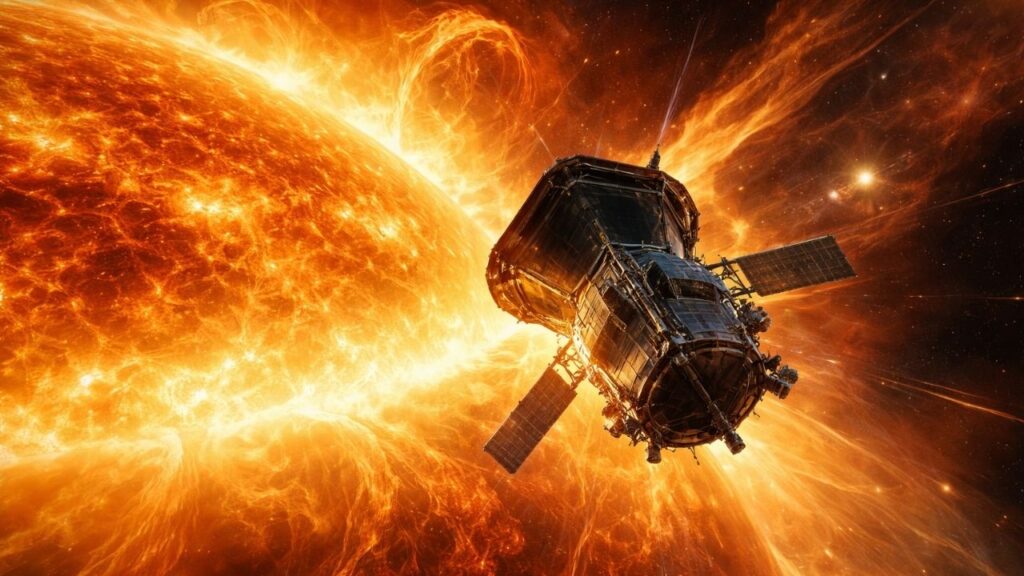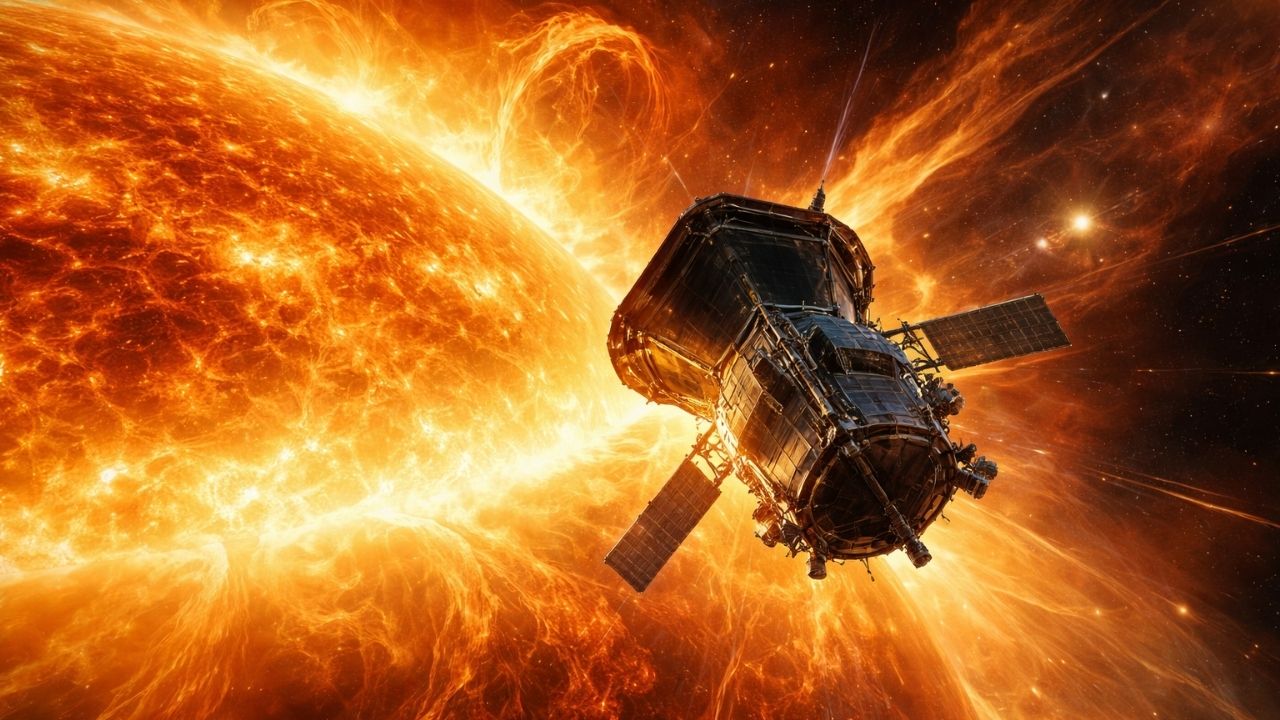
For decades, the Sun was something we observed from a safe distance—a blinding force we could study but never truly reach. That just changed. A spacecraft has now flown directly into the Sun’s outer atmosphere, and what it’s discovering could solve a mystery scientists have struggled with for over 100 years. This isn’t just another space milestone. It’s a turning point in how we understand our star—and how it affects life on Earth.
A Mystery That Shouldn’t Exist

For years, scientists have been stuck on one question that simply didn’t make sense. The Sun’s surface is incredibly hot—around 5,500°C—but its outer atmosphere, known as the corona, is even hotter. In fact, it reaches millions of degrees.
That breaks basic logic. Normally, heat fades as you move away from a source. But the Sun does the opposite. Its outer layers are somehow being superheated by an unknown process, and for over a century, no one could fully explain why.

Solving this isn’t just about curiosity. It’s about understanding how stars work—and how energy moves through space.
The Spacecraft That Made the Impossible Possible
Everything changed with NASA’s Parker Solar Probe. Launched in 2018, this small, heavily shielded spacecraft is designed to do something no mission has ever done before: fly directly into the Sun’s corona.
It survives thanks to an advanced heat shield that absorbs extreme temperatures while keeping its instruments safe. As it loops closer to the Sun with each orbit, it collects real-time data from inside the star’s atmosphere.

In 2021, scientists confirmed something extraordinary: the probe had officially entered the Sun’s corona. For the first time in history, humanity wasn’t just observing a star—we were inside it.
What Scientists Are Discovering Inside the Sun
The data coming back is already changing what we know. One of the biggest findings involves strange magnetic disturbances called “switchbacks.” These are sudden flips in the Sun’s magnetic field that act like bursts of energy moving through space.
Researchers now believe these waves and magnetic twists could be the missing piece of the puzzle. They may be responsible for heating the corona to extreme temperatures and driving the solar wind—the constant stream of charged particles flowing from the Sun.

Instead of a calm, steady flow, the Sun’s atmosphere looks more like a turbulent storm, filled with energy surges and invisible structures shaping everything around it.
Why This Matters for Life on Earth
This isn’t just a distant space story. The Sun directly affects Earth in ways we often overlook. Solar storms can disrupt satellites, GPS systems, radio signals, and even power grids.
By understanding how the solar wind forms and behaves at its source, scientists can improve space weather predictions. That means more warning time before major solar events hit Earth. In a world that depends heavily on technology, this knowledge is becoming essential—not optional.

How Close Is “Close” to the Sun?
To understand just how extreme this mission is, consider this: Mercury, the closest planet to the Sun, stays about 46 million kilometers away. Parker Solar Probe has already flown within about 9–10 million kilometers—and is expected to get even closer.
At those distances, it travels at speeds over 600,000 km/h, making it one of the fastest human-made objects ever created. It dives in, collects data, and escapes—repeating the process again and again.
A New Era of Solar Science
This mission marks the beginning of a new chapter. Instead of guessing from afar, scientists are now gathering direct evidence from the Sun’s most extreme environment.

Each pass of the probe brings new insights. Each dataset refines our models. And slowly, the mystery of the corona—the question that puzzled scientists for generations—is starting to unravel. We’re not just learning about the Sun anymore. We’re learning how stars across the universe behave.
The Bigger Picture: Why This Moment Matters
There’s something deeply human about this mission. For centuries, the Sun has been a symbol—of life, power, and mystery. Now, we’ve taken a step closer than ever before.
This isn’t just about science. It’s about curiosity, risk, and the desire to understand something vast and dangerous. The fact that we’ve managed to send a machine into a star’s atmosphere—and get answers back—is nothing short of extraordinary. And the story isn’t over yet.

Frequently Asked Questions
What is the Parker Solar Probe’s main goal?
Its primary mission is to understand why the Sun’s corona is much hotter than its surface and how the solar wind is generated.
Has the spacecraft really “touched” the Sun?
Yes. In 2021, it entered the Sun’s corona, marking the first time a human-made object reached a star’s atmosphere.
How does the probe survive such extreme heat?
It uses a powerful heat shield made from carbon-based materials that can withstand temperatures around 1,400°C while keeping instruments safe.

What are solar “switchbacks”?
They are sudden reversals in the Sun’s magnetic field, carrying energy that may help heat the corona and accelerate the solar wind.
Why is this research important for Earth?
It helps improve space weather forecasting, which protects satellites, communication systems, and power infrastructure.
How close will the probe get to the Sun?
It is expected to approach as close as 6 million kilometers from the Sun—closer than any spacecraft in history.

What will happen to the probe eventually?
Over time, the harsh solar environment will wear it down. It will remain in orbit near the Sun after completing its mission.