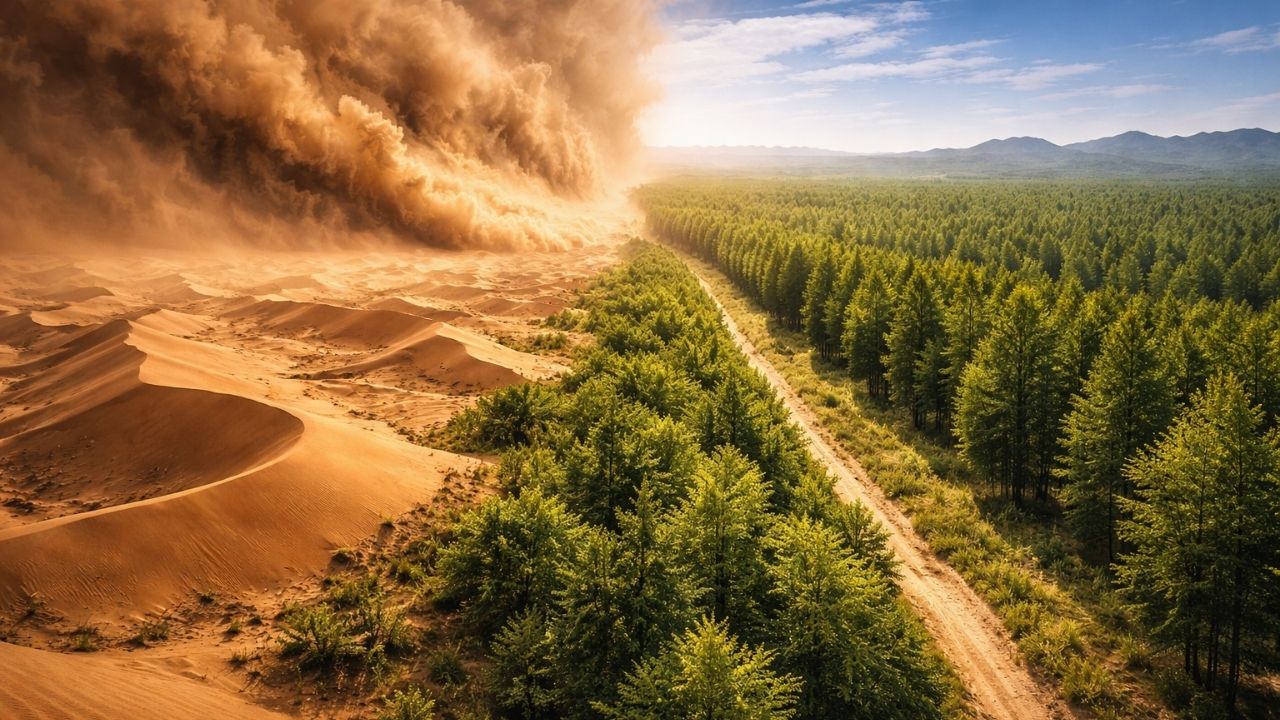
From the train window, the landscape changes almost magically. For miles, there is nothing but dry, pale desert—sand stretching endlessly under a wide, empty sky. Then suddenly, a strip of green appears. Rows of trees stand tall, cutting through the sand like a protective barrier.
A child nearby presses his face to the glass, watching in awe. His grandmother softly calls it “shelterbelt forest”—a line of defense against the desert. These trees are part of one of the world’s largest environmental projects: China’s effort to build a “Great Green Wall” to stop deserts from spreading.
A Growing Desert Crisis

China’s deserts are not static—they are expanding. Every year, powerful sandstorms rise from regions like the Gobi Desert, spreading dust across cities and even reaching neighboring countries.
Latest Stories
 Scientists Capture 8 Incredible Images of Interstellar Comet Passing Through Our Solar System
By the late 20th century, this had become a serious problem:
- Farmland was turning into sand
- Water sources were drying up
- Crops were failing
- Cities were facing frequent dust storms
To fight this, China launched a massive plan in 1978 called the Three-North Shelterbelt Program. The goal was simple: plant trees to block the desert’s advance.
The Idea Behind the “Great Green Wall”
The concept seemed straightforward. Trees could:

- Reduce wind speed
- Hold soil in place
- Improve moisture levels
- Protect farmland and communities
Over decades, China planted billions of trees across its northern regions. Satellite images now show large areas turning green, and in some places, dust storms have reduced. At first glance, it looks like a huge success.
But the Reality Is More Complicated
While the project has helped in many areas, scientists and experts say the story isn’t so simple. Not all green landscapes are healthy ecosystems. Many of the trees planted were:
- Fast-growing but water-intensive
- Non-native species
- Planted in areas naturally suited for grasslands or shrubs
This has created unexpected problems.

The Hidden Problem: Water Shortage
Trees need water—especially large, fast-growing ones. In dry regions, this becomes a major issue.
As these forests grow, they:
- Pull water from underground sources
- Lower the groundwater levels
- Put pressure on rivers and wells
In some areas, this has led to:
Latest Stories
 Meteorologists warn overnight snowfall could reach historic levels, as officials discourage travel
- Drying water sources
- Reduced availability for local communities
- Stress on natural ecosystems
In short, while trees slowed the desert, they also created new environmental challenges.
Monoculture Forests: A Risky Approach
Another concern is the use of monoculture plantations—large areas planted with just one type of tree.
This creates several risks:

- Higher chances of pest attacks
- Lower biodiversity
- Weak ecosystem balance
Unlike natural forests, these plantations often lack:
- Diverse plant life
- Wildlife support
- Soil stability in the long run
Some experts even call them “green deserts”—they look healthy from above but lack real ecological strength.
Impact on Local Communities
The project has also affected people living in these regions. While it created jobs and reduced sandstorms, it also:

- Reduced grazing land for farmers
- Restricted traditional land use
- Changed local ecosystems people depended on
For many, the changes brought both benefits and challenges.
What the Data Really Shows
Research shows mixed results:
Positive impacts:

- Reduced soil erosion in some areas
- Lower intensity of dust storms
- Increased green cover
Negative impacts:
- Declining groundwater levels
- Loss of native ecosystems
- Low survival rate of some planted trees
This shows an important truth:
Planting trees is not the same as restoring nature.
A Shift in Strategy
In recent years, China has started changing its approach.
Latest Stories
 A Mysterious Object From Another Star Is Racing Through Our Solar System—And Scientists Are Stunned
Instead of just planting more trees, efforts now focus on:
- Ecological restoration
- Using native plants
- Protecting existing grasslands
- Stabilizing sand with natural methods
For example, in some areas:
- Straw grids are used to hold sand in place
- Native shrubs are planted instead of trees
- Natural vegetation is allowed to grow back
This approach is slower—but more sustainable.
Latest Stories
 2026 Toyota Corolla Pickup: The Compact Truck That Could Change Urban Driving Forever
Learning From Nature
Experts now emphasize an important idea:
Not every place needs trees.
Some landscapes, like deserts and grasslands, have their own natural balance. Forcing forests into these areas can cause more harm than good. Instead, the focus should be on:

- Supporting natural ecosystems
- Working with the environment, not against it
- Understanding local climate and water limits
The Bigger Lesson for the World
China’s “Great Green Wall” is not just a national project—it’s a global lesson. As many countries plan large-scale tree planting to fight climate change, this experience highlights key points:
- Trees are helpful—but only in the right place
- Ecosystems are complex and cannot be simplified
- Big numbers (like billions of trees) don’t always mean success
- Long-term sustainability matters more than quick results
Between Hope and Reality
Standing at the edge of the desert, the view tells a powerful story. On one side, endless sand. On the other, rows of trees fighting to hold the line. In some places, those trees have made a real difference. In others, they struggle to survive.
The truth lies somewhere in between. China’s effort shows both human determination and environmental limits. It proves that large-scale action is possible—but also that nature cannot be controlled with simple solutions.